Add your promotional text...
The 'Builders and Creators' Mentality
Wanting to create something with our bare hands is a human instinct.
THOUGHTS
1/3/20263 min read
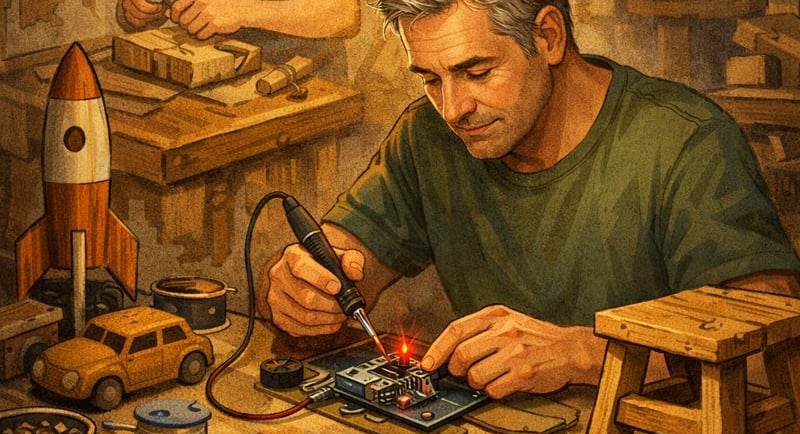
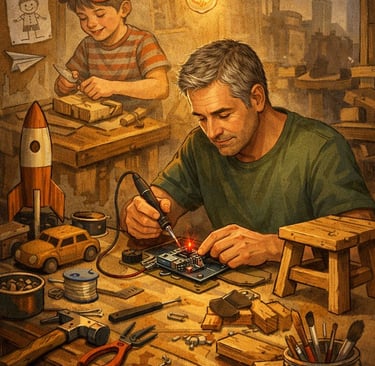
Have you ever wondered why, during our school years, there is always at least one subject dedicated purely to constructing and creating things?
Whether it was electronics, woodworking, metalwork, sculpting, or basic design and technology, almost every education system includes a subject where we are asked not to memorize—but to build. To use our hands. To turn raw materials into something functional, meaningful, or beautiful.
This is not accidental.
Creation and invention are not modern skills; they are human instincts. Long before we learned how to read or write, we learned how to shape tools, create shelter, design weapons, craft symbols, and modify our environment to survive. The act of making things is deeply embedded in who we are.
We don’t merely consume the world—we reshape it.
When a child assembles a simple circuit, carves wood, or molds clay, something deeper is happening. The mind is learning causality. The hands are translating imagination into reality. Failure becomes feedback. Curiosity becomes structure. Creation teaches us responsibility. If it breaks, we fix it. If it fails, we improve it. If it works, we understand why it works.
Yet, as we grow older, many of us slowly drift away from this natural instinct. We are trained to follow systems rather than build them, to use tools rather than understand them, to consume innovations rather than create them. The maker within us goes quiet—not because it disappears, but because it is no longer invited to speak.
That is why those early school subjects matter more than we realize. They are reminders of something fundamental: humans are builders by nature. We think best when we create. We grow fastest when we experiment. And we feel most alive when our ideas take physical form.
As an adult, when was the last time you truly built something with your own hands?
Not assembled. Not purchased. Not ordered online and unboxed. But built.
If you are a woodworker, metal fabricator, scientist, researcher, or someone whose profession or passion revolves around electronics, engineering, or furniture-making, then creation is part of your identity. You live in the act of building and creating things as your source of income.
But for most ordinary citizens, the story is different. For many of us, the last time we created something by hand was during our school years—an electronics project, a simple wooden item, a piece of art made to fulfill an assignment. After that, life slowly transitioned us into consumers rather than creators. We learned to buy solutions instead of building them.
Yet the builder’s mentality should never be allowed to fade. It must be preserved, regardless of age.
When a man says that the seven-year-old boy is still alive within him, what he truly means is this: the desire to create has not died. The urge to explore, to experiment, to make something from nothing still exists. That child was not interested in perfection—he was interested in possibility.
Embrace this builder’s nature.
Construct a simple electronic circuit, even if it does nothing more than light up an LED. Craft a vase from scrap materials. Build a table using discarded wood. Fix something instead of replacing it. These acts may seem small, but they awaken something fundamental within us.
The satisfaction of building something with your own bare hands is incomparable to owning the most expensive, factory-manufactured item produced by machines. One carries a price tag; the other carries meaning.
Creation reconnects us with effort, patience, failure, and improvement. It reminds us that we are not merely users of the world, but contributors to it.
And the journey does not need to start grandly.
Begin small. Turn old, unused items into something useful. Transform waste into craft. Repurpose instead of discard. In doing so, you don’t just create objects—you rebuild a mindset that modern life has quietly taken away.
Because deep down, long after childhood has passed, we are still builders.
What you can do now is simple. Do some DIY. Search the internet for some cool project you can work on to test your 'builders and creators' nature.
Build something with your own bare hands. Then sign it. Let it carry your mark—not for perfection, not for display, but as proof that you still create, not just consume.